
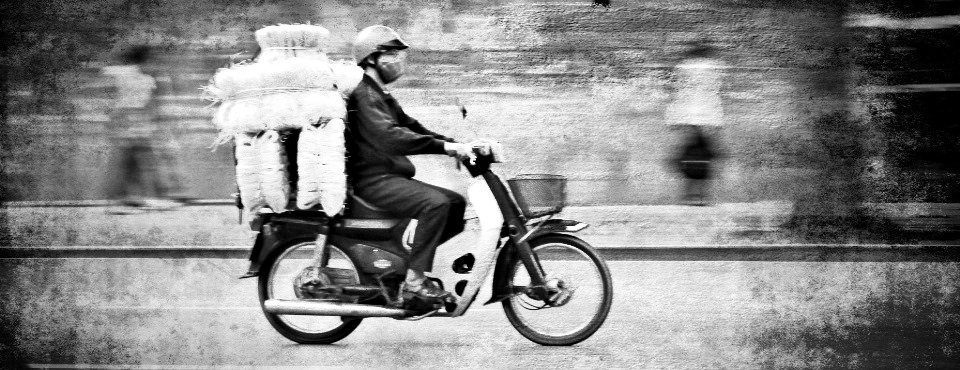
The motorbike. The symbol of Vietnam. The country's utmost point of pride. “90 million people live in Vietnam today, and we have 55 million motorbikes,” one tour operator exclaims. “9 million people live in Saigon. And can you guess the number of motorbikes? Nearly 7 million!” boasts another.
The motorbike. The embodiment of a country defining struggle for independence. A weapon. The blade that slices through traffic-clogged streets and down too-narrow country roads.
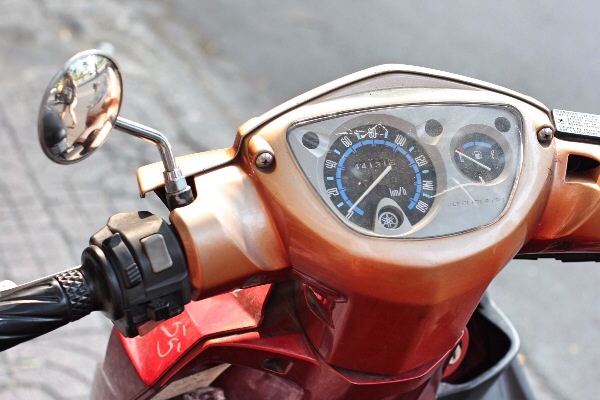
The motorbike, its driver's tenacity and ability to pick apart traffic through a calibrated mixture of cunning, coordination and genetic instinct requires equal parts collective cooperation and individual virtuoso effort. The moto herd moves like a modern symphony – total chaos to create a sense of order. But it is made possible only because each driver must unleash his or her own vicious self interest to efficiently propel the bike through the tangled maze.
Communism and the cutthroat entrepreneurial spirit of capitalism, side by side, on two wheels. In four weeks (often experienced on two wheels, but never on a motorcycle), from top to bottom, Vietnam felt miles away from other countries we visited in south east Asia.
Here, public works exist. Unlike Thailand, Malaysia, Laos, and Cambodia, verdant, manicured parks thrive all over Vietnam. Street sweepers patrol day and night in conical hats. Bus drivers obsessively mop the floors of their night buses (well, mainly because somebody is soon to be shacking up next to your sleeping pod, pod being a term to describe a four foot long enclosure where even an elf would get cramped.)
Uniformed men are everywhere, drinking tea, smoking cigarettes, chatting with coffee shop owners, you know, because looking the part is what counts. But real police presence is elusive, at least outside of Saigon. Maybe a traffic cop emerged to give someone a ticket for not wearing a helmet (helmet being a tin hat that would likely make any skull impact worse rather than better), but no cruiseron cops on patrol. Do northern and central Vietnam have no crime? Does a vast mafia network control the city? A tourist could never tell from the English language newspaper stories where all news is good news – thousands of mines were cleared last week, tourists flock to Vietnam in record numbers, economic growth is continuing at an unheard of pace!

Another headline extols Vietnam's world beating low unemployment. This makes sense, since it seems mixed zoning (or, quite clearly, no zoning) makes everyone a small business owner: each home is an enterprise – sleep upstairs, do business on the ground floor. It can be a tea house, or a motorcycle repair shop, or a travel agent, or maybe you have a few couches set up in your living room and own a karaoke machine and can charge by the song (or take a day off and belt out your own hits away from the mid afternoon heat.) Anything goes, so long as there are no prices displayed anywhere, allowing for maximum profit flexibility, depending on the customer. Don't own two floors? Just holler at tourists from your perch on two wheels, offering lifts, drugs, travel arrangements, restaurant and accommodation tips, you name it.

Often, and unfortunately, the savvy Vietnamese entrepreneuse will transform shortchanging into a sport. In Hoi An, I was buying a deep fried banana pancake snack from a street vendor. It was 15,000 dong for two. I gave her a 50,000 note, then I watched her chat with the other vendor as she counted out change. They didn't think I could see. They were holding bills up to each other, thinking, murmuring, changing the denominations. She chuckled, then turned back to me and handed me back my change, 10,000 short. I looked down, counted, and as soon as I asked for my missing 50 cents, they laughed and immediately pulled out the excess dong. They had it ready all along.
Other times, the downstairs snack shack won't treat tourist dollars like a tooth that requires immediate and aggressive extraction. On one of many DIY rural bicycle tours, Maya and I stopped at a roadside cafe whose English sign just read “HERE” (quotation marks included.) Leery of being taken, but thirsty, sore, and generally not in the mood to negotiate, I grinned and allowed mom n' pop to serve us iced coffee, ginger tea, coconut coated peanuts and a fresh bottle of water. (Now, one is cautioned in Vietnam to always get the price up front. But this couple seemed too kind, too genuine to try to rip us off.) They didn't overcharge, and spent our entire visit smiling at us in the way that grandparents can spend and entire afternoon sitting and smiling at their grandchildren (Maya's grandma, specifically.)
But such radiant warmth would not last: We returned “HERE” the next day, but the old folks weren't there — it seemed like a next of kin was working the register. We asked for water, and she obliged, but at an outrageous price, four times what we paid the day prior. Worse yet, at a lemonade stand a few kilometers away, convinced that mom n' pop's unsavory granddaughter was a one-off in such a rural area, we were gauged by a sweet old lady serving us homemade lemon tea, tea that tasted like Gatorade, and I think I broke her hammock, so call that one even.
Gripes aside, there is too much to love about Vietnam: Ban xeo – a half omelet half pancake embedded with sprouts, chili, garlic and pork, then stuffed with every green herb imaginable, and finally dipped in a half peanut half chili sauce (proportions of which vary by region). The ephemeral beauty of the limestone cliffs jutting out of Lan Ha and Halong bays, witnessed by boat, of course, (and you brought your own beer, it's always 5 o'clock somewhere), but also every morning from the verandah of your $6 a night hotel room equipped with minibar, AC and the Discovery Channel. Biking between hectares of green rice paddies, around ancient pagodas and through manicured cemeteries to a chorus of “hellos!” supplied by every Vietnamese child. Or, the sublime feeling of success after you've bargained your heart out and came out on top for those two Longines watch fakes.
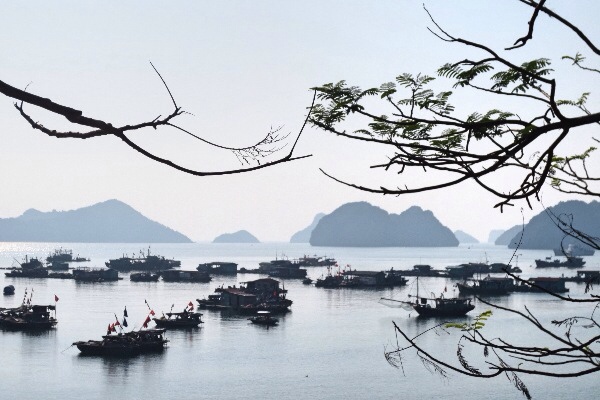
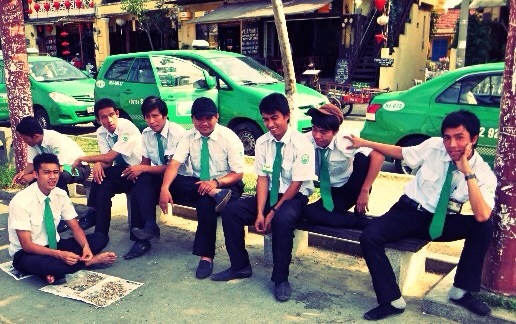
Vietnam doesn't have Thailand's smiles, or Malaysia's ease of travel, or Laos' slow paced majesty. What it does have is the element of surprise. Shortchanged one moment, then bowled over by kindness the next. Jungle rats dangling from hooks on dirty back alleys, flanked by postcard perfect mountains and seascapes. The synchronized motion of millions of motos, a scene so chaotic and scary when encountered an hour after landing in Hanoi, but that suddenly fits seamlessly as you dart diagonally through traffic with a hefty backpack to board the bus to the airport in Saigon.

linda
Apr 14, 2013 -
mimi, my lovely manicurist, has told me more than once that vietnamese people are not nice. much nicer in thailand and cambodia. i am quoting her. cultural thing.